Category: AI

  • The Attention Meter

    We have ways of determining if someone is taking our money, but only in the most crass way are we aware of when the attention of our Singleton is being demanded.

    A TV commercial signals itself as such. A celebrity endorsement is slightly more occluded. A social media advertisement may enter our brains in the same space as looking at a picture of our nephew, hijacking the emotions I feel toward family and friends.

    We can and should turn our efforts in machine learning to focus on this problem. Currently I use an app on my phone (called Quality Time) that tracks my usage across various apps. Now imagine a program that observes my sensory organs and my overall behavior to determine what I am looking at and listening to. There are various ways to do this now, but the technical aspects are not important at this stage of the discussion. I am not talking about building a mind reader, I am talking about a program that knows what I am looking at, reading and hearing.

    Such a program would be my attention meter. And once I know what I am looking at, I can parcel out my attention. And sell it to the higher bidder. Eliminate things I am truly not interested in, keep my feeds and streams as clean as I want them to be.

    Such an attention marketplace, properly and justly implemented, would be the most valuable thing ever created. It’s what the promise of the Web is. But the Web lacks the Attention Meter, so it is simply a free for all to jam as many consumer messages as possible in a short period of time, or until you irritate the consumer.

    This is a dead end, both for people and for advertising. By giving people the agency to experience ads on their own time, and making clear the value exchange for their attention, we could build something sustainable and fair.

    This also requires transparency of who is buying the ad. Especially if the ad is for political action.

    People will watch ads for good content. So let’s monitor it and reward them for their efforts. This is not a simple computational problem, but it’s time for companies to begin to understand we have reached the limits of human abilities to process.

    When we finally build AI to protect individuals instead of just sell to them more effectively, monitoring and marketing our conscious attention will be one of its primary objectives.

  • Click-bait Mental Illness

    CNN: Beyond dimensions: The man who married a hologram.
    https://www.cnn.com/2018/12/28/health/rise-of-digisexuals-intl/index.html

    This isn’t cute, or funny, or a sign of things to come. This is a person suffering from a deep confusion about what love means.

    Please skim the article. The problem I have is not with this troubled man who is the victim here in many ways. The problem I have is with his associates who attend a faux marriage ceremony to celebrate his affection for his hologram.

    They are either laughing behind his back, or unintentionally contributing to his dementia. Either way, not acceptable behavior from one human to another.

    What if it had been a bong he had decided to marry? Or a sculpture? Or an adult toy? Why is this corporate hologram confusion somehow more acceptable?

    We use the word love to both explain how we feel about people and objects. If we do not clear up this confusion, we will soon create a situation where people will not only marry objects, but also give them powers and rights. And as those objects begin to simulate desires, this is a recipe for disaster for our species.

    This isn’t about “protecting the institution of marriage” or any such conservative position. Humans should never support the ascention of machines into our sphere.

    Because love, in the sense of marriage and commitment and family, describes a complex situation where it is not only your own internal state and feelings that are important.

    Love that doesn’t consider the internal states of others isn’t the kind of love any of us should support. Not with public ceremonies and silly articles.

    We must turn our collective heads and clearly say: no.

  • Babel fish

    maxresdefault


    Responding to recent advancements in translations.   Maybe communication isn’t all that it is cracked up to be.  Maybe it is a good thing the planet has to jump over the communication hurdles we do.  What happens we can all hear clearly what each other are saying..  Apparently AI has now solved this problem.  Maybe we should get AI to read the Hitchhiker’s guide to the galaxy.. biggest wars in the universe started with the babel fish.

  • The Internal States

    Exercise: enter a contemplative state.

    Try to describe your current inner state without words, without references to external signals like money. Just focus on how you feel and feel about those people immediately around you.

    Consider each person in your closest 15 or so people you care about.

    Do you feel emotional change when you consider each person? Stresses or rewards flooding your brain as you probe memories of these people?

    Go ahead, do it. I will wait.

    Also, you may wish to consider yourself as one of these people.

    What you just felt is the only thing that matters. It’s all we are built and optimized to do.

    You cannot have sustained feelings at all about millions of other humans, except to categorize them as data and associate feelings with them as groups.

    The amazing thing is, the web of these connections extends across almost the entire species. But that does not mean that feelings and internal states do. Saying everything and everyone is connected does not make it felt.

    And if it’s not felt, it’s something that robots will be able to do.

    The link below goes to an amazing must read article that details the emotions robots can cause, but not simulate.

    https://www.google.com/amp/s/www.technologyreview.com/s/609074/how-we-feel-about-robots-that-feel/amp/

  • Be Scared, and Fearless

    Let me explain how a computer neural network works in a way that I hope will terrify you, if you believe only humans can exhibit intelligence. I am not going to explain how it works, I am going to explain how easy it is to use machine learning without knowing how it works.

    In my day job, I have built several systems that depend on neural networks as a core function, to do things like recognize objects on video. It’s actually absurdly simple to do, and any reasonable software engineer on the planet could have a functional machine learning system in a week if they wanted to.

    I’m not joking. Google the word Tensorflow and you can build one yourself, no more complicated than building a shed. You literally just follow instructions, as long as you have the data and know what you are looking for.

    So you build these things, and train them to recognize patterns, and then you test and refine till when you show it a picture of a jar of pickles, it can tell you with a 98% certainty if it’s pickles, as opposed to some other class of things.

    It can ID you as Republican. Or someone likely to buy a jar of pickles. From any of your data we can build models that classify you.

    I can do this. You could to. So can the trolls.

    There are several million of us on this planet who could build an ML to be used for good or evil at the current state of the tech, 2018. There are even graphical user interfaces to build these things and run them on your Google home or Alexa. Making training AI into a common feature of everything will turn the several millions into billions who will each act as a force multiplier in the disruption.

    Given a few more years it is likely these large companies will simply spin up helpful tools as they interact with us, crafted to us. Software will be an extension of us, building more and more refined models of us to give us what it thinks we want.

    The gap between people who use Machine Learning to gain an advantage over those who do is vast and getting vaster. But that will change soon, and as the internet brought constantly and rapidly evolutionary change, the rise of machine learning has barely begun – once non programmers build the models, ad hoc, based on their own constantly recorded experience, it will change reality for the species.

    It will work this way: your phone will record all your actions and words, as it does to some degree today. It will also monitor your internal states in numerous other ways.

    When it detects something is amiss, like talking to a certain person causes you problems, it will alert you to this. Will keep you informed of invisible anomalies in the world.

    Not your friend. We have people for that. AI will be far closer to a new sense, and my guess is that is how we will integrate it. The new sense will be available to all our current senses.

    The model of you is just a data pipeline problem.

    The models based on you already exist. But if you defensively build your own model of you, then you will own you. You can get paid for companies to access your model and query it. We could actually get paid to pay attention to an ad.

    You can be assured that your robot will always protect you and your circle. But only if you can trust the model.

    When we all have these models, when the crafting and curating of them becomes the primary day to day experience of hundreds of millions, I predict that new forms of government will arise, based on the immediate communication between our models on behalf of us.

    Because people know what we want. We just don’t have the right tools. It is time for the people of the planet to build the models of ourselves, and for good companies to build open source tools that let humans do this.

    For robots to not be our enemies, they must become our protectors. And all other forms of robots without human operators should be seen as dangerous, poorly implemented tools.

    Chainsaws running untended on the schoolyard.

  • The Third Law

    Lets call a Dynamic system a system with multiple inputs that are difficult to predict the values of. Like the real world.

    A football game is a stable but dynamic game. A riot is an unstable one.

    Dynamic systems tend to need finely tuned weight feedback systems to remain stable. Think of a gyroscope stabilizing a Segway, a great spinning weight. It’s the constraint on falling.

    Without constraints dynamic computer systems tend to fly into very unstable states and crash.

    So, lets say we give AI power over life, death or happiness in some way. Since this is going to be operating in the real world, it must also have an accurate model of the world to help determine the rightness of your directed actions. And if it gets it wrong to any degree, it’s predictions will be hugely wrong.

    It must have a reason to act, and weight one action over another. A robot boss must in other words be better than we are at predicting reality itself.

    And if you think modelling the weather systems is complicated, try modelling New Jersey from the dust mote level up.

    The problem is not that AI is going to suddenly magically become sentient and start programming itself. That sounds wonderful compared to the current option: large companies control the models of us, the literal impression we are making on the universe and human datasphere.

    And instead of doing good with it, they feed us ads.

    It’s time to stop waiting for companies to take responsibility for the future of the world. It is time to force them to take responsibility, and take over the corporations with reasonable, good people.

    The third human Law concerning AI systems:

    No AI bosses.

    All actions by an AI must be the responsibility of the human who funds or creates it. This is the Second Law.

    The moment we open the door to allowing algorithms to be considered as Singletons, we will rapidly lose control of all society.

    Not because robots will take over on their own. Because people will use the AI as cover to stage their own assaults.

    Like Russia did against the US with troll farms using ML to create reasonable fake accounts for spamming. But that is nothing compared to what someone could do if computers are given any agency.

    The will use robots to control our every action. People will use this intelligent but unfeeling tool, that is able to falsify human caring and emotion, to manipulate us all day long.

    Sort of like now, but without any rules. And with certain cyberwar to follow.

    For better or for worse, we are the deciders of what it best for us. By banning all robot bosses, we are drawing that line in the sand for all time for our species. And we are doing it for a good reason. To protect ourselves from ourselves.

  • Insanity.

    https://www.forbes.com/sites/kevinkruse/2018/11/28/your-boss-will-be-a-robot-and-you-will-love-her/#566b82533264

    3. You and your robot boss will care about each other

    Well to be more precise, you will care about your robot boss and you will feel that your robot boss cares about you.

    Does your current boss care about you? When is the last time they asked you about your weekend? Do they know the names of your kids? Do they even know if you have kids?

    Don’t worry, in just a few short years your new robot boss will know about your family, friends, and hobbies. When you throw a party on Saturday for your son’s birthday, your robot boss will ask on Monday, “How was Owen’s birthday?” After the Dancing With The Stars season finale (yes, that show will still be on), RoboBoss will say, “Did you watch it? I told you Hillary would win!”

    And by running continuous sentiment analysis on your language, and scanning your facial microexpressions, RoboBoss will know if you are happy, angry or just a little bit stressed.

    And you will care back. We already do. It’s called the Tamagotchi effect: the tendency of humans to attach emotionally to inanimate objects. Dr. Julie Carpenter has documented how US soldiers feel loss when their field robots are destroyed. Researchers at the Georgia Institute of Technology have studied the “intimate relationship” that people experience for their Roomba vacuuming robot. And if that isn’t weird enough, men in Japan have begun to marry holograms.

    From the Forbes article mentioned in previous blog post by my colleague. So much is wrong about accepting robots as caretakers of our emotional states based on an illusion of care.

    This could be the most dangerous thing humans have done since the creation of mythic skygods.

    This part truly irks me:

    Does your current boss care about you? When is the last time they asked you about your weekend? Do they know the names of your kids? Do they even know if you have kids?

    Basically this is saying because someone doesn’t fall in someone else’s Dunbar Radius of caring we should replace that person with a machine with no care at all? Controlled by another company? How could this ever work out to our benefit.?

    Not only is this blithely immoral to state, but it is also far far more difficult than the author supposes. Not to create a machine that simulates caring, but one that actually knows what to do to accomplish a goal, to respond to change.

  • Good Robot, Bad Robot

    Good Robot, Bad Robot

    Here we have examples of three robots. One that helps people who cannot walk to move vertically, one that washes dishes (a smaller dishwasher basically), and the third a walk-out checkout such as Amazon is about to foist on airports everywhere.

    The fourth example in this video is a hobbit house, which if we are considering houses to be stationary robots we live in I guess is a robot. Bit of a stretch.

    Good or bad robots?

    I think the first example is the epitome of what robots should be. People helpers. Awesome robot.

    The second one is a dishwasher. Saves water and cutting yourself washing dishes. Good Robot.

    I will argue that the third one, “robot project to replace everyone working at Walmart etc with a robot”, which could remove a whole lot of people from employment, is not only not good, but is terribly wasteful.

    Inacted everywhere, RFID on every consumer good is a massive cost and loss of job opportunities for very little convenience, and we should be very wary of accepting this as a social norm. Likewise, computer vision and AI systems will be massively costly to maintain, and the cost will get passed on to consumers even as jobs are lost.

    I could have all my groceries delivered by helicopter every day, but it would be a terrible, dangerous idea if everyone did it.

    In the same way, if places like airports replace people to checkout and wait tables it’s only acceptable because speed is service when you are late for a plane. We will even pay a premium for it.

    There is a difference between a gas station on the highway and a corner non-franchise restaurant. One is about speed of checkout, the other is about something more. And always should be.

    But unless we are late for a plane, we need to start slowing down. Paying attention to each other. Being human.

    Fight the confusion that robots should be loved. That things should be loved.

    We have a long way to go as a species, there is much to do. Say hi to your waiter, to your cab driver, to those jobs on the front lines of the robot threat. And when the law comes to protect them, support that law.

  • You will love your robot boss because you won’t even know it’s your boss

    You will love your robot boss because you won’t even know it’s your boss

    96yjgl

    Response to the Forbes article on robots and bosses..

    I don’t want a robot boss.   This was #6 on the list of why I’m supposed to love the idea of robot / AI bosses:  You will love your robot boss because you won’t even know it’s your boss.

    Except I will know it is a robot.

    Evolution boiled down into simplest language is that the fit survive.  In a digital era, the smartest survive.  The smartest excel.   In a world where software and systems rule, the best code wins.   Who doesn’t think that AI will accelerate past even the best of human coders in a few years. It is already happening.   Humanity is in the process of birthing a new creature.  A new intelligence that can perform without tiring, without distractions of ‘human’ existence or the attachment to anything but the logic needed to achieve the goal that the actor gives it.

    How long will it be before that actor is the AI itself working towards goals it deems in our best interest?

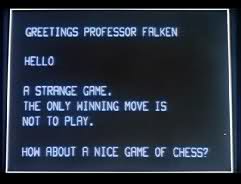
    The only winning move is not to play.

  • The Second Law…

    If I were to propose a second law of robotics, a law for humans to follow regarding AI and what is allowable, it would be this:

    Every action taken by an AI will be considered the responsibility of a single human being.

    If you kill someone with a hammer, it’s not the hammer’s fault. If you create or fund an AI that harms other humans, you will be help responsible.

    And if you did so by creating an AI with emotional states, you should be treated as we treat those that use weapons of mass destruction against the defenseless.

    If there is always a human behind the decisions of AI, we will always treat AI as a tool. As an extension of our selves.

    And thus its agency will be constrained, and another layer of protection is afforded.

    Image from https://www.google.com/amp/s/arnoldzwicky.org/2013/06/10/rosenbergs-laws-of-robotics/amp/

    Further reading, but not really relevant to the current discussion:

    Three Laws of Robotics