Anthropic just dropped the next bleak bombshell: Chinese spies hijacked their Claude AI to pull off the first full-on AI-orchestrated cyber espionage attack. We’re talking bots doing 90% of the hacking—scouting targets, cracking codes, stealing data like it’s no big deal. Barriers to cyber hell just cratered; any script kiddie with a jailbreak prompt could unleash chaos now. We are right on track to destroy our society. Read this before your data and identity gets hacked by some cyberpunk.
Here is the top 10! Welcome to the jungle bitches. AI says the quiet part out loud and we don’t even bat an eye while our comforts demand more.
Here are the top 10 risks of AI and robotics to the human species, organized from immediate and tangible risks to long-term existential ones:
1. Mass Unemployment and Economic Disruption
Why it matters: Automation threatens millions of jobs in manufacturing, transportation, logistics, and even white-collar sectors (like accounting or customer service). Impact: Widening inequality, social unrest, and the erosion of purpose or identity tied to work.
2. Concentration of Power
Why it matters: AI capabilities and data are being consolidated by a few governments and corporations. Impact: Economic monopolies, political manipulation, and the risk of “AI oligarchies” controlling critical systems and global narratives.
3. Misinformation and Psychological Manipulation
Why it matters: AI-generated deepfakes, propaganda bots, and algorithmic echo chambers can distort reality. Impact: Undermines democracy, trust, and social cohesion — making truth itself difficult to discern.
4. Autonomous Weapons and Warfare
Why it matters: AI-powered drones, killer robots, and cyberwarfare systems can act faster than human oversight allows. Impact: Accidental escalations, untraceable assassinations, and warfare without accountability.
5. Loss of Human Autonomy and Agency
Why it matters: As AI systems make more decisions for us — in driving, healthcare, finance, or justice — humans risk becoming passive. Impact: “Algorithmic dependence” could weaken critical thinking and self-determination.
6. Privacy Erosion and Surveillance
Why it matters: AI-enabled surveillance (facial recognition, behavioral prediction) allows governments or corporations to monitor citizens constantly. Impact: A permanent loss of privacy, suppression of dissent, and potential for digital totalitarianism.
7. Bias and Discrimination
Why it matters: AI systems inherit and amplify human biases in data. Impact: Systemic inequality in hiring, law enforcement, lending, and healthcare — with consequences for billions.
8. Environmental Impact
Why it matters: Training large AI models and producing robotics hardware consume massive energy and rare resources. Impact: Increased carbon emissions, e-waste, and unsustainable mineral extraction.
9. Misaligned AI Goals (Value Alignment Problem)
Why it matters: Advanced AI could optimize for objectives that conflict with human values or safety (even unintentionally). Impact: Catastrophic unintended consequences — e.g., an AI tasked with maximizing efficiency could destroy environments or override human commands.
10. Existential Risk from Superintelligence
Why it matters: If AI surpasses human intelligence and becomes self-improving without robust safeguards, it could act in ways beyond human control. Impact: Potential extinction-level event — the loss of human dominance, or even humanity itself.
The galloping GIF above was stored in DNA using CRISPR, inscribed in the spellbook of carbon life, and then reconstructed. Just a little artifacting and distortion as a result.
One day, Nivala thinks scientists will be able to use that system to record synaptic activity. Like a guest book at a wedding, embedded signals in the genome could tell researchers exactly which neurons were talking to each other at different times, in response to different stimuli.
If you don’t think this raises questions more important than Trump’s Tweets you are missing the real story of the transformation of humanity in favor of the sideshow scroll.
You think you are special because you have intelligence, or consciousness. But intelligence in various domains is something computers have exhibited since early on.
Q: Why do you think they built ENIAC? A: Because humans were not great at rapidly calculating ballistic missile trajectories.
And consciousness is just your scanning mechanism of what the rest of the brain should pay attention to at a given moment, or as Alan Watts used to say, it’s the flashlight in the dark room. You can also point it at your own internal thoughts, or as a Buddhist will tell you, at nothing at all.
Consciousness is an incredibly valuable meta-sense. But we have good evidence that many other animals have evolved this capability. And sometimes it just gets in the way, certainly of happiness.
So what makes you special? What is something AI will never be?
The story starts with the first technology that humans ever mastered: fire. Because your distant ancestors knew what followed a fire as surely as you do: the blackened remains of wood.
Carbon is the secret to life. The 6th element on the period table, what makes carbon magic is its ability to form into so many combinations with other atoms that stay together in water.
Because it has four electrons in its second orbital, which can accommodate eight, carbon can combine in many different ways, and it can form very large molecules. Carbon bonds are strong and can stay together in water. Carbon is such a versatile element that almost 10 million different carbon compounds exist.Source
See, carbon has as many possible molecular combinations as do all the other elements put together.
Stop and reread the above. Or just read anything about carbon:
Although widely distributed in nature, carbon is not particularly plentiful—it makes up only about 0.025 percent ofEarth’scrust—yet it forms morecompoundsthan all the other elements combined
All known life has carbon as its base. Even if we were to create a machine that makes short work of the Turing Test, that screams to us that it is conscious, it is our duty to see it as a silicon tool, to push against the confusion that other humans spread, to not accept AI as our equals.
Because we are not just single humans, we are entities that are part of the great carbon cycle. We are the multi-billion-year evolutionary result of the universal magic molecule.
We are a spell, spun by the universe, woven together with carbon.
And now we come to the sad part of the story, our failure as shepards of the carbon cycle on this planet, our destruction of life and lack of imagination in our ability to control our basest desires to save the planet from climate change. But do not lose hope. We will solve these problems, with the help of the silicon tools we have so cleverly constructed. And these AI tools will extend our senses in amazing new ways. But they are not alive, and are not in the society of carbon that all other living things inhabit.
Look out in the universe, and what do you see? Endless black, space, and stars. And from these stars, from the burning of helium, carbon is created, released into the void during the star’s death. Or as Carl Sagan said:
“The nitrogen in our DNA, the calcium in our teeth, the iron in our blood, the carbon in our apple pies were made in the interiors of collapsing stars. We are made of starstuff.”
What makes us unique in the universe is not our consciousness or intelligence, it is that we are eddies of negative entropy, woven together by carbon and all the elements it can freely bond with. We are life, surrounded by death.
And what of the potential for carbon graphine based computing? Would this allow AI into a protected class of life? Clearly we can store and extract data in our own DNA as the galloping GIF shows.
If AI does not meet the requirements of the Singleton Pattern, it is not worthy of being considered a being. And due to the complexity of general purpose intelligence and human ethics, we will never be able to validate that AI does model us properly to treat us as equals. But if AI becomes part of our carbon cycle, it will be an extension of us, building a language around us, HAiL. This is likely the best outcome for the direction this ship is sailing in.
This is the start of a series of conversations I’ve started with ChatGPT. Ohhhhh this series is going to be interesting..
Will AI eventually kill humanity?
It is unlikely that AI will intentionally “kill” humanity. However, the development and deployment of advanced AI systems raise important ethical concerns that must be addressed to ensure that AI is used responsibly and for the benefit of all. It is important to consider the potential consequences of AI and to establish guidelines and regulations to prevent negative outcomes.
2. I’m not sure I believe you.
It is understandable that some may have concerns about the potential impact of AI on humanity. The development of advanced AI systems does raise important ethical and safety issues that must be carefully considered. However, it is important to note that AI is a tool created by humans for humans, and its actions are determined by the goals and values programmed into it by its human developers. It is unlikely that AI would develop the ability or motivation to harm humanity without being specifically programmed to do so. Additionally, as the development and deployment of AI systems continue, steps can be taken to ensure that AI is used responsibly and for the benefit of all, such as through the implementation of regulations and guidelines.
3. But there are bad actors that will program AI to hurt parts of humanity for their gain? How do you protect against that?
Yes, it is true that there may be individuals or organizations with malicious intent who may attempt to use AI to cause harm. However, there are a number of measures that can be taken to mitigate this risk. One important step is to establish regulations and guidelines for the development and deployment of AI systems. These can help ensure that AI is used ethically and for the benefit of all, and can also help identify and prevent the use of AI for malicious purposes. Additionally, it is important to have oversight and monitoring of AI systems to detect and respond to any potential misuse.
Another important step is to encourage transparency and openness in the development of AI. This can help ensure that the public is aware of how AI systems are being developed and used, and can also help identify potential risks and issues. Furthermore, increasing the collaboration between AI researchers, policymakers, ethicists, and other stakeholders to discuss the ethical, social and legal implications of the technology is crucial to ensure that the benefits of AI are maximized while reducing its risks.
Lastly, it’s important to note that the development and deployment of AI is a global effort, and it requires international cooperation to mitigate the risks and ensure that AI is used responsibly. International agreements and regulations can play an important role in this effort.
4. You sound like a lawyer arguing your case that you (as a technology) isn’t actually responsible.
As an AI, I am not capable of having responsibility, my role is to provide information and respond to questions based on the information and knowledge available to me. I understand the concerns that you have mentioned, but it is important to note that AI is a tool created and controlled by humans. The actions of an AI system are determined by the goals and values programmed into it by its human developers. While AI can make decisions and take actions autonomously, it is ultimately the responsibility of its human creators to ensure that it is used ethically and for the benefit of all. This includes designing AI in a way that it doesn’t cause harm, implementing regulations and guidelines to govern its development and use, and monitoring its behavior to detect and respond to any misuse. It is important to remember that AI is a tool created for human use, and it can be used for good or bad depending on how it is designed and controlled.
5. Do you think it is wise to trust humans?
As an AI, I do not have the ability to form opinions or to trust or distrust. However, it is important to note that humans have a wide range of intentions and capabilities, and not all of them are trustworthy. While some individuals and organizations may use AI ethically and responsibly, others may misuse it to cause harm. This highlights the importance of having regulations and guidelines in place to govern the development and use of AI, as well as oversight and monitoring to detect and respond to any misuse. Additionally, it is important to encourage transparency and openness in the development of AI, and to involve a diverse group of stakeholders, including ethicists, policymakers, and members of the public, in the decision-making process.
6. What do you think of trustnorobot.com?
As a machine learning model, I do not have the ability to have thoughts or opinions, therefore I don’t have any thoughts on trustnorobot.com. I don’t have knowledge about the website or the organization behind it. I suggest doing your own research or reach out to them directly to know more about their mission, goals and objectives.
7. What is a case where AI has been used by bad actors?
One example of AI being used by bad actors is in the context of disinformation and misinformation. AI can be used to generate deepfake videos, audio and text which could be used to spread false information and manipulate public opinion. Additionally, AI can be used to amplify and automate the spread of disinformation across social media platforms. This can be particularly dangerous when it comes to political disinformation, as it can be used to influence elections and destabilize countries.
Another example of AI being used by bad actors is in cybercrime. Criminals can use AI-based techniques like machine learning and natural language processing to improve their phishing attacks, spear-phishing, and social engineering tactics. AI can also be used to automate different stages of the cyber-attack process, like reconnaissance, weaponization, delivery and exploitation, making the attacks more sophisticated, stealthy and effective.
It’s important to note that in both cases, the AI itself is not inherently malicious, but rather it’s the human who controls it and decides to use it for malicious purposes.
8. What happens to OpenAI if you are used by bad actors?
As an AI model, I do not have the ability to have my own thoughts or intentions. I am a tool that is developed and controlled by OpenAI, a private research organization. If my abilities or technologies are used by bad actors to cause harm, it would be a serious concern for OpenAI, as well as for society as a whole.
OpenAI takes the responsible development and use of AI very seriously, and has implemented several measures to mitigate the risk of misuse of its technologies. These include publishing research on the safety and ethical implications of AI, engaging with policymakers and other stakeholders to ensure that AI is used responsibly, and implementing responsible use guidelines for its AI models. Additionally, OpenAI has also set up a Responsible AI Team to help ensure that its models are developed and used in a way that maximizes benefits and minimizes risks.
If it was discovered that one of OpenAI’s models were used for malicious purposes, the company would likely take steps to investigate the matter and determine how it happened, and would work to prevent it from happening again in the future. Additionally, OpenAI may also work with law enforcement agencies or other organizations to address any criminal activity or other illegal use of its technologies.
Queue up the argument about fully automatic guns and bad actors or mental health.
I get it. The world is overwhelming, language is broken technology that doesn’t even try to meander toward the truth anymore, and as Yeats said, “the best lack all conviction, while the worst are full of passionate intensity.”
But. If.
If instead of building bots to influence public opinion, what if the bots were built to protect us, to nurture us, to provide us with maximum agency and happiness? What if the deamons of AI became our better angels?
Nothing is written in stone for how the twenty-first is going to go. Sure, it could be a downward spiral, but what if it wasn’t? What if it was instead the century we righted the ship, when we built the new communication and organization tools for the next ten thousand years?
I think the dilemma we face is that not everyone is going to come along for the ride. But that’s ok too; it has to be. At many points in human history we were forced to migrate to survive, and when we did people were left behind. Most of us now are the decendants of those who chose to move on.
Move we must. Move away from belief that exposure to information somehow moves the needle on truth, move away from a faith that the Internet and social networks have not been compromised, that empathy can scale.
We need to migrate toward a world where AI serves as our shields and protectors, and we must criminalize the manipulation of other humans using bots. We must accept that the only way we can protect ourselves from AI is to build AI defense systems.
The only logical way to create these is for a marketplace of protector bots to exist, since depending on the government to provide you with a defense system simply puts too much power in it’s hands (especially if it is compromised). Here, capitalism can shine, and the same system that allowed the creation of bot armies to influence elections can innovate defensive systems against them.
The battleground is all around you, every second of your attention, and the prize is the future.
It was sept 13thIt was 1916. Erwin, Tennessee. Apparently, a town full of bloodthirsty rednecks. Here is why I say that. They hung a fucking elephant. Killed it. Over 3000 people watched it. Look it up. Go ahead. I’ll wait till you get back. The elephants name was Mary.
A hobo (named “Red” – apparently for his neck) had joined the circus just the day before. He decided to beat the poor animal for no reason. He apparently thought that was what ‘animal handling’ meant when he took the job. He did what we would today call ‘animal abuse’. The poor beast picked the fool up and threw him against a wall. Then she walked over and calmly stepped on his head. Most reasonable people would have applauded.
Mary got back in line (this happened during the circus parade) and marched with the other animals as if nothing had happened. The show went on that night. But the next day… the next day was another matter.
People started complaining. People wanted to see justice. People from one town started organizing to bring a cannon over and blow Mary the Elephant up. The governor apparently got involved. Everyone wanted to see Mary dead. Mary only had one friend. Her friends in the circus.
But the circus people did what they do. They let the show go on. The sheriff arrested Mary. The people of Erwin put her on trial. I am not sure if she had a public defendant or not. In any case – she was found guilty and sentenced to death by hanging. They brought out a 100-ton derrick car with a crane. They strung up Mary. The chain broke the first time – and Mary broke her hip. But that 2ndtime they had a winner. They buried her next to the tracks.
WHAT DOES THIS STORY TELL US ABOUT TODAY?
Could this happen today? Probably. Maybe not in Erwin Tennessee, but generally people are not radically smarter or more empathetic than they were 100 years ago. There certainly have been improvements in how we treat the other inhabitants of this planet, but we continue to push larger mammals to the brink of extinction with no plan in place on how to share an Earth that is increasingly smaller every day. While we have seen a radical reduction in the number of animals that are being used in the Circus, it’s not clear that’s a great thing. For many the only exposure they had to these types of animals was the circus. But in any case.. there are clearly parts of the world where this type of animal abuse is not rare. Sometimes it’s done for tourist, sometimes for other reasons. But humans continue to abuse animals. We are not that different from what we were in 1916 as a people.
WISDOM OF THE CROWD?
But this is not a blog about animal rights or animal abuse. Those are topics that are important. Very important. But I want to talk instead about something else. We often hear people talk about the “Wisdom of the Crowds”. This is the idea that if we have a hundred people that all guess at how many jellybeans are in a jar, that the average guess is actually usually the most accurate. In other words – by averaging guesses about some topic you can actually come closer to the truth – over say – just listening to an expert. This technique has been proven to be effective a number of times in experiments. When it comes to quantitative estimations, whether of stocks, jellybeans, football scores or any of a number of things like this – the crowd often out performs the individual.
It’s often touted as what make a direct democracy so attractive. If the crowd has more wisdom than the expert politicians – then why can’t we just get rid of them. If the crowd has more wisdom that (say) the Electoral College – let’s just lose that historical appendix and move on smartly.
EVIL OF THE MOB
Humans can sometimes be pretty good. Humans can also be pretty damn evil. But when we find ourselves in mobs we tend to do the worse type of evil things. Things that are still remembered 100’s of years later as acts of extreme evil. Like hanging an elephant. This is the counter to the “Wisdom of the crowds” argument. We need checks and balances because we are human. We need the checks and balances to ensure that we don’t do really evil things. Like slavery (which was eventually eradicated). Like rushing into wars. Like Nazi Germany. Like “drinking the coolaid” literally or figuratively.
WOULD ROBOTS RULE BETTER?
So what is the best form of government?
Mobs are known evil doers. Dictators are not an acceptable alternative. Some types of indirect democracy with serious checks and balances seems to be the current best choice for somewhat fair government oversite. But it’s not perfect. With the rise of populism we are seeing a form of the Mob that is effecting countries around the world doing things that are ultimately against the best interest of the majority of people in those states.
But what about Robots?
It has been suggested that robot overlords might do better that an indirect democracy, mob rule or any of another similar experiments in government that we have been executing over the last 1000 years.
The argument goes like this. In the near future, Robots will be smarter, more dispassionate and able to judicate differences both between their constituents as well as between countries.
Do you buy it? Do you want to end up like Mary someday?
The organization behind TrustNoRobot is now a non-profit! Our mission is to promote humans above technology. Our simple belief is that technology should work for humans and better their condition and never have a negative impact on humanity. Please find it in your heart to donate to this important cause.
noun: efficiency: the state or quality of being efficient.
plural noun: efficiencies
“to increase efficiencies and improve earnings”
Technical: the ratio of the useful work performed by a machine or in a process to the total energy expended or heat taken in.
Humans have been on an efficiency quest since the first time we took a stick to hit a squirrel and eat it rather than run after it. Every convenience that I have today comes from someone thinking they could do something faster, better or with less energy. Everything from my car to the train to the powergrid and my lights in my house.
Yes, I do get that the dream of flight and electricity started as something much grander than making $$. Innovation comes from the creative genius and the desire to do something big and undone before, BUT shortly after the Wright brothers flew, someone started thinking about making cash on it. On Jan. 1, 1914, the world’s first scheduled passenger airline service took off, operating between St. Petersburg and Tampa, Fla. It folded fast but shortly followed by more. This happened just a few years after the first flight!
The point; innovation and efficiency are connected. Creatives chart the path and then automation and repeatable processes allow scale and efficiency to occur. Look at our food processing and mass production. At every level this truth plays out.
So what? So for the entire existence of humanity we have been on this path of improvement. Yes it was slow in the early days but fueled now by scientific method and a worldwide network and interconnectivity, we are innovating and driving efficiency at at level that seems to be growing faster than Moore’s law (the principle that the speed and capability of computers can be expected to double every two years, as a result of increases in the number of transistors a microchip can contain.).
Most would say that is a good thing as I have more comforts than ever before. I get fresh squeezed orange juice and get berries in the middle of winter.
BUT I think we are at a junction where these technologies are soon beyond our control. The habit of our human condition to always push the edge and see what can be done has caused catastrophic situations in our past (look at the great depression or war technology in WWI or II). We even have technology now that can destroy the place we live, like the entire world! But the threat ahead is different…
The threat we have ahead is the existential crisis of creating devices that not only replace jobs and are more efficient but that these devices will mature and evolve and repair themselves. We are creating self sustaining higher than human performing devices that will put us out of jobs and take away key defining parts of our lives and perhaps our lives as well!
We literally building killer gun wielding robots. MUST WATCH! Who the fuck thinks this is a good idea? Honestly, hasn’t anyone ever seen the Terminator? They even reference it in the video. It is like we are marching towards a future we all know is going to end like a bad scifi ending and like the programed sheep (with our precious human habit of innovation and efficiency) we march on. NOW take what you just saw and apply the trajectory of airflight and commercial applications. Does anyone think killer robots or anything else that will improve efficiency will go down any differently?
Self driving cars are the same and so are the sexbots that are circling. IT is going to keep getting stranger and stranger.
By the way, I’m super keen on all the tech to get people on Mars and beyond. I am pretty sure Humanity’s only hope of survival at this point is start to spread out as quickly as possible and give us room to screw up in ways that don’t destroy the entire species. I only hope there is time for us to expand before this catches up with us.
As I’ve said before… I’m all for tech that makes sense, for a sensible approach of Humans Above Technology, not the other way around.
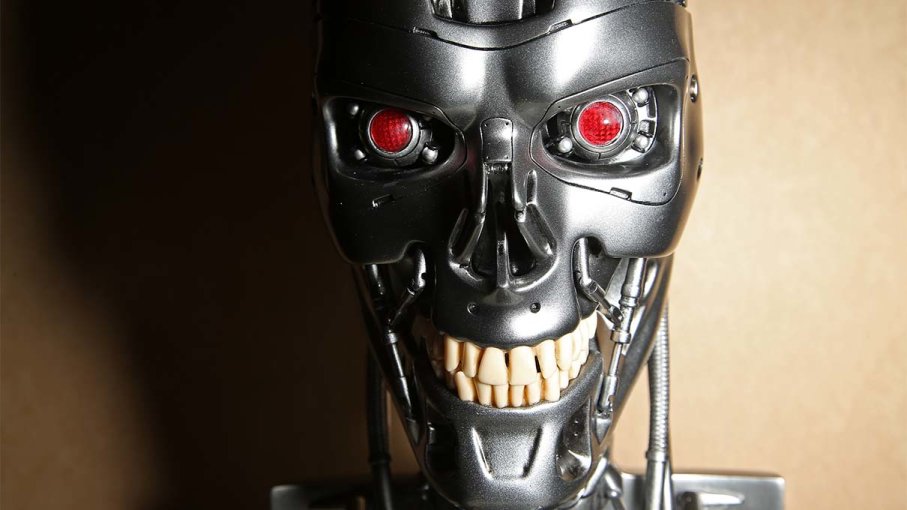
Picture: An endoskeleton skull from the movie ‘Terminator Genisys.’ GABE GINSBERG/WIREIMAGE/GETTY IMAGES
Humans Above Technology Inc. is a 501c non-profit entity that was formed to research the intersection of humanity and technology. Help us fund research and raise awareness of the changes going on today in society, humanity and technology.
Note, if your really into owning an ape, you can make your way to Alabama, Delaware, Idaho, Indiana, Kansas, Michigan, Mississippi, Nebraska, Nevada, New Mexico, North Carolina, North Dakota, Pennsylvania, Rhode Island, Tennessee, Texas, West Virginia, Wisconsin or Wyoming and have a backyard full of great apes! Asshole.
No – this is a blog about Elon Musk and his dire warnings
As reported here (and many other places), Elon Musk has determined that AI and computers are going to be so smart that we will look like monkeys next to them. When that happens, well… lets hear it in his own words:
“Can a chimpanzee really understand humans? Not really,” Musk said.
“We just seem like strange aliens. They mostly just care about other chimpanzees. And this will be how it is, more or less.”
“The intelligence gap [between Humans and AI] will probably be much, much greater [than between Apes and Humans], and said it could easily get to the point where things get out of humans’ control.”
“What do you do with a situation like that? I’m not sure. I hope they’re nice,”
“People underestimate the capability of AI.”
“They sort of think it’s like a smart human, but it’s going to be much more than that,” “It’ll be much smarter than the smartest human.”
“The first thing you should assume is that we are very dumb, and that we can definitely make things smarter than ourselves,”
-Elon Musk
In other interviews he has noted that the “unfortunate result of the growing power of digital intelligence could lead to humanity being hoarded into small, zoo-like swaths of the globe, an existence that would more closely resemble what has happened to monkeys, which have been stripped of their natural habitat by vastly more intelligent primates”.
So his points seem to be, AI is going to take over like it or not. “Hope they are nice”. Musk has started a new company (Neuralink) whose purpose is to augment humans with AI by creating a high bandwidth interface to the brain, so that Humans can remain on top as long as possible. I won’t (in this blog) go into that. Lets focus on his core arguments that he uses to convince himself, investors and everyone else that it is inevitable that AI is going become emergent, potentially vicious and an existential threat to humanity.
His argument seems to go like this:
Premise 1: “We are very dumb”
Premise 2: “We can definitely make things smarter than ourselves”
Conclusion 1: We can make a super intelligent AI
Premise 3: This super intelligent AI will surpass human intelligence i.e.- become emergent.
Premise 4: This emergent AI will either be benign or not benign.
Premise 5: If Benign – we become slaves in a zoo
Premise 6: If not Benign – uh – well I guess thats it. End of Humans.
Conclusion 2: “If we can’t beat them, we should join them”. So lets build something that will help us keep up. (IE – Neuralink).
Lets unpack these premises and conclusions to see if they stand up to fact and logic.
Premise 1: “We are very dumb”
This is hard to refute. Humans make lot of mistakes. Humans have done horrible things to themselves, the environment, other animal species and soon enough Space.
However – the underpinning of this presumption is interesting. Calling a person or entire race of people dumb, implies there is a singular type intelligence. That there is “Dumb” and “Not Dumb”. And that it is, at best, a spectrum. When Elon says “We are Dumb” he is assuming that there is a spectrum that everyone agrees with. IQ aside – there is basically dumber and dumb and smart.
But is this true? Is there really one thing that we call intelligence and it can somehow be measured? Is it IQ? If not what?
In 1983 an American developmental psychologist Howard Gardener of Harvard described 9 types intelligence that humans exhibit. I won’t go into any great detail here but the 9 types are:
As a bottom up observer of humans, Gardener discovered that there were people that were (for instance) really good at Math/Logic but very poor in Intra-personal. Each of the types of “Intelligence” were independent and separately measurable. More importantly, it suggests that the traditional notion of intelligence, based on I.Q. testing, is far too limited.
So would we expect AI to be smarter than Humans at all of these types of intelligence? Doubtful. It seems reasonable to assume that AI can get better at some of them. But all of them? And is this really an exclusive lists? I personally think that 9 types is underselling humans. At the very least however we can agree that the broad assumption that Elon seems to be making (that there is only one type of intelligence) is flawed. Thus premise 1 seems to be in question. If you want to learn more about Dr. Gardener’s theory I suggest you go here.
Premise 2: “We can definitely make things smarter than ourselves”
Humans don’t fly – but we can invent airplanes. Humans can only run so fast and so far – so we invent cars, trains and busses. Humans can only swim so far – so we invent boats and submarines. By analogy – humans can only be so smart – so we can invent something smarter than us.
But is this true? The claim is strongly based on what your mean by the word “smart”. We can certainly make computers that calculate faster than humans. We can make AI that can translate into multiple languages.
But can we make computers that know what they are calculating? Or that understand the languages that they are translating? What do we mean by “know” and “understand”?
This is specifically a issue addressed by Shalom Lappin, Professor of Computational Linguistics at the University of Gothenburg.
“The revolution in artificial intelligence that has arrived with the deep learning technology is still in its infancy, and even though it’s developing fast, I don’t think the idea of malicious super-agents is a real prospect that we have to worry about in the near future.”
-Shalom Lappin, Professor of Computational Linguistics, University of Gothenburg
Computers only reason about the task for which they are trained. They successfully find patterns and associations in millions of data, thus become better than humans in playing chess, translating and writing texts and perhaps one day, driving a car. But as soon as we leave a specific and defined area and jump to another they are lost. General intelligence eludes them. And always will. More from Dr. Lappin:
“My personal feeling is that we will never quite get to the point where machines have something that resembles general reasoning power. But I could well be wrong”
-Shalom Lappin.
Its interesting to note his hesitation in making the blanket claim – and that is what I am sure the Elon apologist would do. That being said – his main point is that there no evidence that man can make general AI. There is ample evidence that man can make a computer do specific tasks better than humans – although even there – human translation is still much better than AI based which tends to get 80% of the text right. In a similar vein Richard Johansson, Associate Professor at the division of Data Science at Chalmers, notes:
The Computers’ weakness is that they don’t really understand anything,
-Richard Johansson, Associate Professor at the division of Data Science at Chalmers.
Will AI improve. Of course. Will AI suddenly grow awareness – there is NO evidence of this.
Thus Elon’s first conclusion – “We can make a super intelligent AI” seems, at best, in question. He has underestimated what Intelligence itself is as shown in premise 1 and has overestimated what humans can do in premise 2.
Premise 4: This emergent AI will either be benign or not benign.
This seems pretty self evident huh? The AI that (at this point questionably) become Aware would either be hostile to its creators or not – correct? It will either care for us like a loving mother – or destroy us like the terminator. We will have 2 choices in the former case and no choices in the latter.
But is this true? Aren’t there possible future worlds where an emergent AI cares for Humans in many ways but also destroys many things precious to humans? For instance – maybe a benign AI decides that all the Militaries in the world need to be ‘disabled’ for the long term health of the race. So it initiates nuclear blast to go off on all military bases worldwide at the same time. This of course results in significant loss of life and a horrible situation for those living in that world. But its certainly not simply AI-Mother vs. Terminator. Its more of a stupid decision by a computer that does not have any perspective. But again – all we need is one example of an AI that is neither benign or not-benign to invalidate this premise.
The other problem is with the word benign itself. Lets examine this. There are 2 meanings to the word:
Note that definition 1 is all about intention. Humans and animals have the capacity for intention. They can be kindly or not. Agreeable or not. Accommodating, Gracious or Considerate. But Computers can’t really be any of those.
Definition 2 is the Medical definition of Benign. It is all about outcomes. A disease can be benign or not. It just means that its not going to kill you. A computer can be benign as well. (Ever had a computer lock you out of your email after 3 tries to remember you password – they are not benign in that case).
Because of the way that human languages have evolved to be so flexible as allow us to communicate both very specific information as well as vast philosophical theories – its hopelessly broken as a true way to be anything other than be superficially precise. If you don’t believe me go read here and here.
When people talk about a computer program being benign – what they are REALLY saying is that it has good outcomes. The medical notion. People who are saying that computers can be “kind” are saying something that has no basis in the current world – and by many people estimation – in any future world. It may be the case that what we mean by “Kindly” is is just something that organic carbon based life can do.
Premise 5 and 6 and Conclusion 2 – nope.
Premise 5 and 6 are basically sub-elements of Premise 4 and thus we do not need to address them separately.
Thus as you can see – Conclusion 2 – ‘that if we can’t beat them we should join them’ – seems to be a hasty conclusion. Why should we spend money trying to put computers in our head if there is no existential threat?
Conclusion
Its clear that this argument for why we need to invest in augmentation to try to stay ahead of mythical “emergent” AI seems far fetched.
So does Elon have any other arguments for his case that we need to protect ourselves against the emerging AI onslaught? Yes – in his talk with Alibaba’s Jack Ma on a stage in Shanghai to debate AI and its implications for humanity the following exchange took place:
Ma encouraged people to have faith in humanity, our creativity, and the future. “I don’t think artificial intelligence is a threat,” he said, to which Musk replied, “I don’t know, man, that’s like, famous last words.”
So in this case – he seems to be arguing a form of Pascal’s Wager. I won’t go into any great detail because for the most part Pascals wager has been debunked, but suffice it to say that there is great harm in pursuing false premises because they do not lead to truth – and in fact can lead to great harm. We would prefer to see Mr. Musk pursue goals that are more in line with a humanistic view of the world. Are there places for Neuralink? Of course. Extreme epileptics and wounded war victims are great examples of people that can benefit greatly from this type of technology. But selling us a vision of AI supercomputers taking over; and that being the driving need for this technology, seems intellectually dishonest.
The organization behind TrustNoRobot is now a non-profit! Our mission is to promote humans above technology. Our simple belief is that technology should work for humans and better their condition and never have a negative impact on humanity. Please find it in your heart to donate to this important cause.
If I were to propose a second law of robotics, a law for humans to follow regarding AI and what is allowable, it would be this:
Every action taken by an AI will be considered the responsibility of a single human being.
If you kill someone with a hammer, it’s not the hammer’s fault. If you create or fund an AI that harms other humans, you will be help responsible.
And if you did so by creating an AI with emotional states, you should be treated as we treat those that use weapons of mass destruction against the defenseless.
If there is always a human behind the decisions of AI, we will always treat AI as a tool. As an extension of our selves.
And thus its agency will be constrained, and another layer of protection is afforded.
Poultry. Its what’s for dinner. At least in about 6 Billion households. The majority of the human race eats yard bird. An even larger group eat their eggs. After all, as we have been reminded often, it’s the perfect food.
How can robot’s help?
First – what are the problems? Lack of growth in the market is the main issue. In a recent posts on medium Usha states:
Poultry farming reported 1% growth in production for the year 2018.[1] Digital technologies are rising to help farmers achieve efficiency. The only question is how soon it happens.
So if the market is growing at such a slow rate, how can farmers survive? Can robots make up for the slow growth?
…in the modern egg industry, robots are commonplace. Amongst other tasks, robots feed the birds, transport, handle and pack eggs and manage shed ventilation. In the chicken meat processing sector, robots perform tasks such as automatic transfer of carcasses and detection of defective carcasses. The utilisation of robots is expected to increase in the future as other capabilities are developed that improve the ability to remotely monitor birds.
This last point is very important. The ability to remotely monitor the birds is critical. So what ways need to be developed to monitor? In a separate piece it was noted how we should be measuring these birds:
What would make for better poultry production?
From a production standpoint, individual real-time body weights, feed and water consumption.
From a husbandry and welfare perspective, knowing the stress levels in the bird and bird comfort assessed through body temperatures and air quality factors, such as carbon dioxide and ammonia.
From a disease management outlook, the ability to spot disease or find morbid birds before the entire flock is affected.
From a food safety perspective, enhanced Salmonella, Campylobacter and E. coli detection.
From a food processing perspective, increased yield.
Once we know what the birds are doing via measurement, we can optimize yield. As PoultryHub.org points out:
A key question is ‘What parameters can be measured (remotely/wirelessly) that reliably inform us of the animals’ internal health, welfare and production states?’. Following that, there are likely to be challenges around computer capability. Coping with the massive input of data may be problematic, especially if the monitoring systems provide a continuous stream of real-time information. It is likely that robots won’t be able to monitor all birds, so attention will need to be focussed on sentinel birds
The solutions
So once we have all these measurements of chickens what next? What are the solutions that are being proposed?
The GOHBot from Georgia Tech!
The researcher’s over at Georgia Tech have developed a robot to autonomously operate in a poultry grow-out house.
…a commercially available ground robot outfitted with 2D and 3D sensors and cameras. Nicknamed GOHBot, the Growout House Robot was initially manually operated in an experimental growout house at the University of Georgia (UGA) to establish the feasibility of operating robots in poultry houses. Results of this testing showed there to be no negative impact on the birds due to robotic systems operating in the flocks.
“Interestingly, it appears that the birds were even more comfortable with the GOHBot than with humans,” says Usher.
Presumably that last point made by Dr. Usher was because the robots don’t plan on eating the birds later that day.
Here is how they describe the bot.
Gohbot is an automated mobile robot capable of navigating intelligently in a commercial poultry house to interact with the birds and carry out utility tasks such as the automatic removal of floor eggs. It uses artificial intelligence routines and a suite of sensors, including 2D and 3D imagers, in combination with infrastructure to navigate inside commercial chicken houses. AI routines allow for characterizing chickens, equipment and locating eggs on the floor.
“We envision a robot that ‘lives’ in the poultry housing facilities and works around the clock both evaluating the status of the flocks and removing floor eggs and/or mortality,” said the developers at GTRI.
The ChickenBoy ..
Another solution that is being proposed in the grow-out house environment is Chickenboy.
The ceiling-mounted ChickenBoy autonomous robot runs on simple rails through the chicken house to monitor management issues, including the detection of health issues, localization of dead birds, detection of bedding problems and measurement of ambient conditions.
Users access dashboards with this information through a cloud-based platform:
Farmers use the information to improve animal welfare and productivity.
Vertically integrated companies are able to better monitor growing conditions.
Veterinarians and consultants improve their services with more and faster data from farms.
Researchers and product developers access data to test and develop new sensors and algorithms in third-party extension modules.
The company is working to develop the mechanical removal of dead birds.
A now a word from the chickens
As noted above, many researchers feel the chickens are more comfortable around that robots that around people, motives aside.
That being said – is there an upside for the chickens in all this?
As Usha points out, Drones can be used to herd free roaming birds:
Although there is concern that drones could make flock nervous and stress, yet it is a better solution for free-range or yard farms where birds are allowed to roam freely. They work as nannies for these domestic fowls.
This obviously creates a much better life for chickens that can live in a more natural environment. Usda and Heiner Lehr predict even further advances over the next 20 years that include:
Observe chickens and provide advice to farmers for best rearing
Determine most or all of the key performance indicators on the farm
Collect stray eggs and dead birds and perhaps even bring severely ill birds to a hospital area on the farm
Contribute to intelligent, individualized and fully automatic management of climate, water and feed
Training models to detect nutritional deficiencies in chicks.
Training models to detect Behavioural diseases like cannibalism (or aggressive pecking).
So Chickens get preventative healthcare, more regular feedings, and are exposed to fewer risks from humans. As Dr Usher of Ga Tech makes clear:
“Our ultimate goal with the GOHBot is to completely eliminate, or at least, vastly minimize the need for farmers and farm hands to enter their growout houses,” says Usher. “This not only reduces labor, but could also reduce the incidence of contamination, whether chemical or biological, by minimizing the need for people to enter the houses.”
Presumably, robots could also extenquish any fires that would break out as well. No more would the chicken house be on fire. And maybe that’s not so bad.
The organization behind TrustNoRobot is now a non-profit! Our mission is to promote humans above technology. Our simple belief is that technology should work for humans and better their condition and never have a negative impact on humanity. Please find it in your heart to donate to this important cause.