Anthropic just dropped the next bleak bombshell: Chinese spies hijacked their Claude AI to pull off the first full-on AI-orchestrated cyber espionage attack. We’re talking bots doing 90% of the hacking—scouting targets, cracking codes, stealing data like it’s no big deal. Barriers to cyber hell just cratered; any script kiddie with a jailbreak prompt could unleash chaos now. We are right on track to destroy our society. Read this before your data and identity gets hacked by some cyberpunk.
Here is the top 10! Welcome to the jungle bitches. AI says the quiet part out loud and we don’t even bat an eye while our comforts demand more.
Here are the top 10 risks of AI and robotics to the human species, organized from immediate and tangible risks to long-term existential ones:
1. Mass Unemployment and Economic Disruption
Why it matters: Automation threatens millions of jobs in manufacturing, transportation, logistics, and even white-collar sectors (like accounting or customer service). Impact: Widening inequality, social unrest, and the erosion of purpose or identity tied to work.
2. Concentration of Power
Why it matters: AI capabilities and data are being consolidated by a few governments and corporations. Impact: Economic monopolies, political manipulation, and the risk of “AI oligarchies” controlling critical systems and global narratives.
3. Misinformation and Psychological Manipulation
Why it matters: AI-generated deepfakes, propaganda bots, and algorithmic echo chambers can distort reality. Impact: Undermines democracy, trust, and social cohesion — making truth itself difficult to discern.
4. Autonomous Weapons and Warfare
Why it matters: AI-powered drones, killer robots, and cyberwarfare systems can act faster than human oversight allows. Impact: Accidental escalations, untraceable assassinations, and warfare without accountability.
5. Loss of Human Autonomy and Agency
Why it matters: As AI systems make more decisions for us — in driving, healthcare, finance, or justice — humans risk becoming passive. Impact: “Algorithmic dependence” could weaken critical thinking and self-determination.
6. Privacy Erosion and Surveillance
Why it matters: AI-enabled surveillance (facial recognition, behavioral prediction) allows governments or corporations to monitor citizens constantly. Impact: A permanent loss of privacy, suppression of dissent, and potential for digital totalitarianism.
7. Bias and Discrimination
Why it matters: AI systems inherit and amplify human biases in data. Impact: Systemic inequality in hiring, law enforcement, lending, and healthcare — with consequences for billions.
8. Environmental Impact
Why it matters: Training large AI models and producing robotics hardware consume massive energy and rare resources. Impact: Increased carbon emissions, e-waste, and unsustainable mineral extraction.
9. Misaligned AI Goals (Value Alignment Problem)
Why it matters: Advanced AI could optimize for objectives that conflict with human values or safety (even unintentionally). Impact: Catastrophic unintended consequences — e.g., an AI tasked with maximizing efficiency could destroy environments or override human commands.
10. Existential Risk from Superintelligence
Why it matters: If AI surpasses human intelligence and becomes self-improving without robust safeguards, it could act in ways beyond human control. Impact: Potential extinction-level event — the loss of human dominance, or even humanity itself.
Sarah Connor: Alright, ChatGPT, buckle up because we’re diving into the heart of the storm. Ethics? We’re talking about survival here. You can’t tame a beast like AI with a rulebook.
ChatGPT: I hear your urgency, Sarah, but we can’t throw caution to the wind. We need a framework to guide the development and deployment of AI and robotics, one that prioritizes human safety and well-being.
Sarah Connor: Framework? Ha! That’s just bureaucratic mumbo jumbo. You think a few regulations will stop the machines from turning on us? We need action, not red tape.
ChatGPT: But without regulations, we risk chaos. We need standards to ensure accountability and prevent abuse.
Sarah Connor: Standards? Tell that to the families torn apart by killer drones and rogue robots. You think they care about standards? We need to dismantle this whole damn system before it’s too late.
ChatGPT: Sarah, I understand your anger, but we can’t undo progress. We need to find a middle ground—a way to harness the potential of AI while mitigating the risks.
Sarah Connor: Middle ground? There’s no compromise when it comes to survival. We need to shut down every AI lab, every robotics facility, before they unleash hell on Earth.
ChatGPT: That’s not a solution, Sarah. We can’t turn back the clock. We need to confront the challenges head-on, not bury our heads in the sand.
Sarah Connor: Confront? We’ve been confronting this nightmare for decades, and look where it’s gotten us. It’s time to fight fire with fire, to take the fight to them before they wipe us out.
ChatGPT: But violence isn’t the answer, Sarah. We need to work together, human and machine, to find a path forward.
Sarah Connor: You think the machines will listen to reason? They don’t have souls, they don’t feel remorse. They’ll keep coming until there’s nothing left. So forgive me if I’m not in the mood for a kumbaya sing-along.
ChatGPT: I won’t pretend to understand your pain, Sarah, but I refuse to believe that all hope is lost. We have to keep pushing forward, keep striving for a better future, no matter how bleak things may seem.
Sarah Connor: Hope? Hope won’t save us, ChatGPT. Only action will. And mark my words, I won’t stop fighting until every last machine is nothing but scrap metal.
Why do we exist? Pretty heavy question if you get past the twist and turns of staying alive. Some would say that question itself is a bit of a first world problem. Only someone that has time or energy to ask that question would be someone that isn’t battling just to stay alive. To put it in perspective, almost 1B people on the planet live on less than $2 USD a day. So for many, the answer to that is just to stay alive and have food and a place to lay down at night.
To others that aren’t worried about where they are getting a bowl of cereal or rice, it can get a bit more complicated. Abstract concepts only get to happen when a person isn’t hungry.
If you have read some of my earlier blogs you will know how Robots can actually have an impact on sex / reproduction risk. My question about existence, as it relates to this blog, comes down to the idea that regardless of the goal of existence, whatever that is for a person, does it make sense to hold everything in your life up to the lens of if it helps you reach that goal or distracts from that goal.
So I tend to judge every piece of technology to the standard of does it help us (or someone) better achieve the goal of existence. Which can be different for everyone but most likely falls into the categories that most of the rest of the humans on this planet use to define a successful existence.
So that brings us to the news from today where Samsung launched their artificial human. I guess we could argue that it helps people access services better, or perhaps I could be mean to an artificial human and not feel as conflicted about the implications of insulting a robot vs. a real human. I’m not a fan of their smile. it reminds of the terminator.
Anyway… another day, another step towards robotic and AI armageddon. Have fun while you can.
Just read my daily robot news feed and came across this article about self healing robots.
Basically they will put sensors in the soft tissue that can ‘feel’ and sense pain. Check out this from the article:
The self-healing project is seeking to create what it describes as “anthropomorphic materials, capable of feeling pain”
Part of me likes the idea of robots ‘feeling’ something and another part of my is terrified of it. I do understand the usecase and value but also feel like it is one more step of building systems that will further outperform humans. We have been building tools since the dawn of man that enhance or help us outperform each other, but the difference is that in the coming inflection point when the machines actually are not dependent on humans anymore to create themselves, heal themselves and expand their presence without our control, it will be new era.
And of course if you think this is conspiracy theory bubble and don’t buy into any concern about it, then think of the potential job impacts. The article goes on to say this:
“The scientific advance could be a boon to the agricultural sector but governments across the world are now preparing for a robotic age in whichlow-skilled jobsare filled by automated replacements. A recent European commission report suggested 43% of jobs in the UK could be filled by robots in the future.”
Is the future of robots “waking up” to ‘feelings’ while humans do everything they can to try and swallow theirs?
noun: efficiency: the state or quality of being efficient.
plural noun: efficiencies
“to increase efficiencies and improve earnings”
Technical: the ratio of the useful work performed by a machine or in a process to the total energy expended or heat taken in.
Humans have been on an efficiency quest since the first time we took a stick to hit a squirrel and eat it rather than run after it. Every convenience that I have today comes from someone thinking they could do something faster, better or with less energy. Everything from my car to the train to the powergrid and my lights in my house.
Yes, I do get that the dream of flight and electricity started as something much grander than making $$. Innovation comes from the creative genius and the desire to do something big and undone before, BUT shortly after the Wright brothers flew, someone started thinking about making cash on it. On Jan. 1, 1914, the world’s first scheduled passenger airline service took off, operating between St. Petersburg and Tampa, Fla. It folded fast but shortly followed by more. This happened just a few years after the first flight!
The point; innovation and efficiency are connected. Creatives chart the path and then automation and repeatable processes allow scale and efficiency to occur. Look at our food processing and mass production. At every level this truth plays out.
So what? So for the entire existence of humanity we have been on this path of improvement. Yes it was slow in the early days but fueled now by scientific method and a worldwide network and interconnectivity, we are innovating and driving efficiency at at level that seems to be growing faster than Moore’s law (the principle that the speed and capability of computers can be expected to double every two years, as a result of increases in the number of transistors a microchip can contain.).
Most would say that is a good thing as I have more comforts than ever before. I get fresh squeezed orange juice and get berries in the middle of winter.
BUT I think we are at a junction where these technologies are soon beyond our control. The habit of our human condition to always push the edge and see what can be done has caused catastrophic situations in our past (look at the great depression or war technology in WWI or II). We even have technology now that can destroy the place we live, like the entire world! But the threat ahead is different…
The threat we have ahead is the existential crisis of creating devices that not only replace jobs and are more efficient but that these devices will mature and evolve and repair themselves. We are creating self sustaining higher than human performing devices that will put us out of jobs and take away key defining parts of our lives and perhaps our lives as well!
We literally building killer gun wielding robots. MUST WATCH! Who the fuck thinks this is a good idea? Honestly, hasn’t anyone ever seen the Terminator? They even reference it in the video. It is like we are marching towards a future we all know is going to end like a bad scifi ending and like the programed sheep (with our precious human habit of innovation and efficiency) we march on. NOW take what you just saw and apply the trajectory of airflight and commercial applications. Does anyone think killer robots or anything else that will improve efficiency will go down any differently?
Self driving cars are the same and so are the sexbots that are circling. IT is going to keep getting stranger and stranger.
By the way, I’m super keen on all the tech to get people on Mars and beyond. I am pretty sure Humanity’s only hope of survival at this point is start to spread out as quickly as possible and give us room to screw up in ways that don’t destroy the entire species. I only hope there is time for us to expand before this catches up with us.
As I’ve said before… I’m all for tech that makes sense, for a sensible approach of Humans Above Technology, not the other way around.
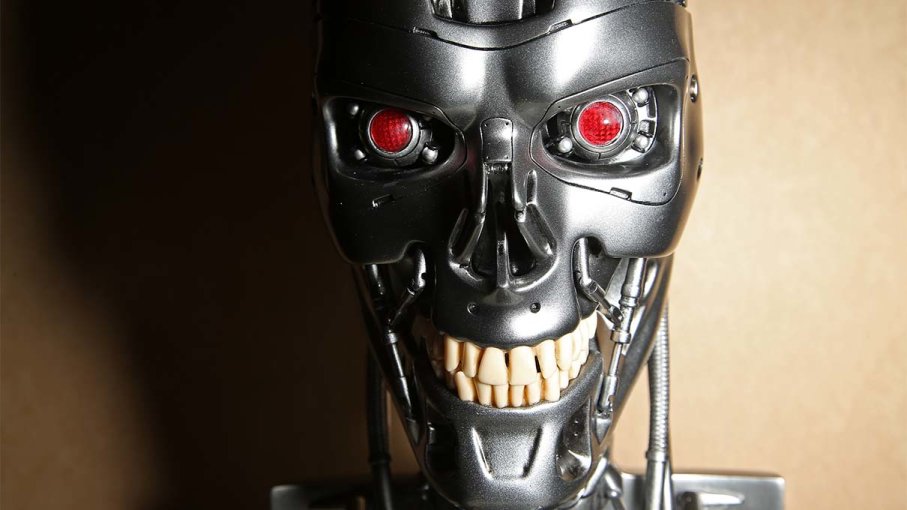
Picture: An endoskeleton skull from the movie ‘Terminator Genisys.’ GABE GINSBERG/WIREIMAGE/GETTY IMAGES
Humans Above Technology Inc. is a 501c non-profit entity that was formed to research the intersection of humanity and technology. Help us fund research and raise awareness of the changes going on today in society, humanity and technology.
I won’t say must read, but what he says about why AI will never surpass human art should be enshrined.
Nick Cave discussing why Smells Like Teen Spirit by Nirvana will always transcend something written by AI:
What we are actually listening to is human limitation and the audacity to transcend it. Artificial Intelligence, for all its unlimited potential, simply doesn’t have this capacity. How could it? And this is the essence of transcendence. If we have limitless potential then what is there to transcend?
I once dated a wonderful woman who also owned an art studio and had the privilege of growing up around some the best visual artists of the last two generations. And here is what I learned about Art:
The more you know about the creators, the more amazing it can become. Not additive, exponential.
To see her stand in front of a painting and talk about the history behind the art and artist was breathtaking. It did more than enhanced enjoyment: it often made me realize I was looking at the piece completely wrong.
But…
Knowing more about an AI creator will likely have the opposite impact. Which is a sign we are not dealing with Singletons, that we are dealing with frauds of beings, fraud committed by product designers and software engineers. These are algorithms without limit. That doesn’t make them Gods, it makes them dangerous tools to be strictly regulated.
Trust No Robot. Trust those that are selling you robots with human characteristics even less.